“As a person in a non-normative body, I have to make adaptations all the time. Making these adaptations in the day-to-day expands what I am willing and able to think of in the creative context because I'm used to looking outside the norm and coming up with new ways to do things.”
— Jesi Yager
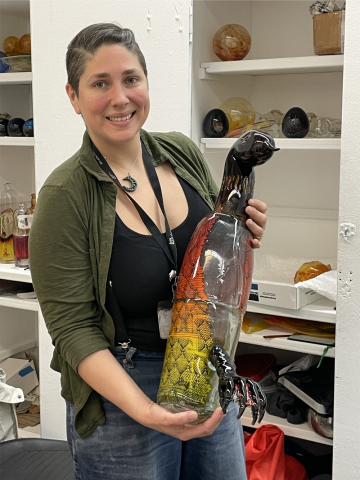
For Jesi Yager, the path to her MFA at Alberta University of the Arts has been defined by transformation — not just in concept, but in lived experience.
A candidate in the MFA Craft Studies program specializing in glassblowing, Yager approaches material as something to be pushed, reworked and reimagined. Her work challenges the physical boundaries of traditional processes, reshaping them to meet her body through adaptation, invention and persistence.
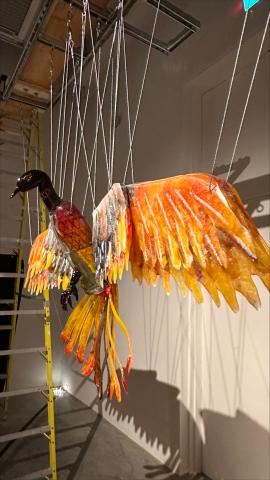
Four months before she began her MFA program at AUArts, on the day she knew her leg would be amputated, she had a vision of a phoenix rising from the intense heat of the hot shop. That image of fire and renewal would become a guiding force in her work. Her return to the studio marked a profound reset: a chance to rebuild not only her practice, but the very conditions of making itself.
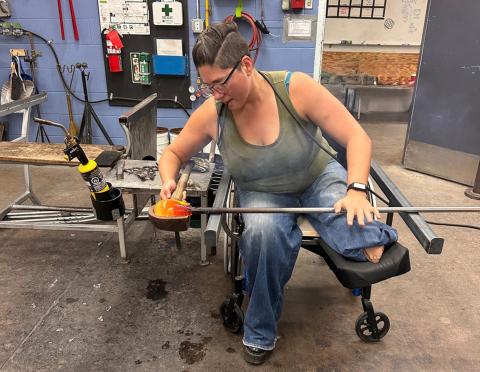
The result of Yager’s thesis work, “Feet, what do I need them for if I have wings to fly” — Frida Kahlo, is featured in the MFA Thesis Exhibition 2026 at Illingworth Kerr Gallery, as well as in Adapt at Marion Nicoll Gallery, which reveals the glassblowing tools and systems that she has re-invented and transformed to fit her physical needs and make her work possible.
A practice shaped by transformation
Originally from the United States, Jesi Yager's path to glassblowing began in 2013, following earlier studies in sculpture and painting. She first encountered the medium through an apprenticeship in Vermont, going on to work in a range of craft studios and shops.
After relocating to California and establishing a mobile glass studio, Yager’s practice was interrupted by serious health challenges that ultimately led to amputation.
Soon after, she discovered AUArts’ MFA program, applied on short notice, and was accepted — moving to Calgary just four months after her amputation.
Her work at AUArts has centred on processing that experience, drawing on themes of transformation and renewal through the metaphor of the phoenix.
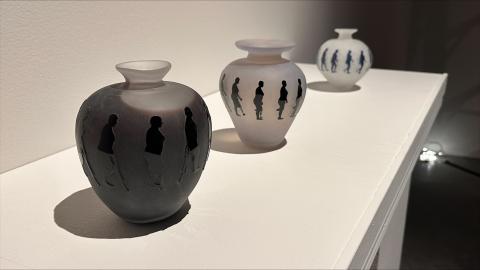
AUArts’ Lisa Wong interviewed Jesi Yager about her experience as an MFA candidate. Some questions and answers have been edited for clarity and brevity.
Finding glass
AUARTS: Tell me a little bit about your art practice.
JESI YAGER: I'm originally from the States. My partner's from Calgary, which was what brought me here initially. I've been blowing glass since 2013.
Before that, my BFA was in Sculpture and Painting. I still do a lot of mixed media work. I love working with metal and wood and and fibre and really playing with materials. Glass has got its own magic for sure.
When I first started blowing glass, I was like, “This is what I'm supposed to be doing. I found it. This is the answer I've been looking for.”
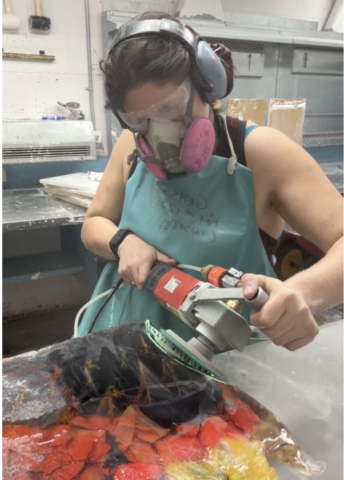
AUARTS: How did you discover it?
YAGER: I had been working at a chocolate factory and was trying to find something arts related. I was living in Vermont at the time, and I knew that there were some local glassblowers, and I just reached out to some studios nearby and said, "Any chance you would want an apprentice? Because I think I would really like to try glass."
I went down to an open studio. I stayed for the 12 hours of open studio time that weekend while they were doing their demonstrations and immediately sort of fell into helping and assisting in the workshop. I ended up working at five different craft shops within half an hour of where I lived in rural Vermont.
After about five years, I relocated to California and discovered that it's expensive to run a glassblowing hot shop in California. I ended up buying a mobile studio and starting my own studio there.
I started out by working in the parking lot at my friend's business during COVID, outside under a little pop-up tent in Burbank, California. I continued working there until I stopped being able to walk. I then had three years that I couldn't walk or work at all. That was up until my amputation.
The amputation changed my life in the best way possible. I woke up out of pain for the first time in three years in the hospital. Four months later, I started at AUArts.
AUARTS: How did your amputation affect your art?
YAGER: I started here four months after the amputation. I didn't really have a prosthetic yet. I was using a knee crutch and regular crutches as a mode of getting around. I was able to use the knee crutch in the hot shop. But all of my work was about processing and relating this experience, which for me was the liberation from pain.
Everybody's experience around amputation is different. Traumatic situations are a very different thing than saying, “I want my life back.” Because I had agency in the decision and even had to fight for it in the US medical system, for me it was a very positive thing. It gave me my life back.
Why AUArts?
AUARTS: How did you end up here?
YAGER: My partner is from Alberta. I came up here to visit her. I was looking for places in Calgary to connect with other glassblowers. Saw that the university had glassblowing and that there was an MFA.
It was an MFA program that was written basically how I would design it if I were choosing to go back to graduate school.
The timing was sort of this mid-career restart where I had just gotten my life back. I was able to move, I was able to go back to the hot shop. If I was ever going to have the opportunity to go to school, the timing was perfect. I reached out to Admissions and said, “Is there any way I can come and tour the school? I would love to see it.”
After I visited the school, everything just fell into place, like the universe had aligned specifically to open this path for me. At the end of the summer my partner and I drove back down to New Mexico, packed up my life and moved me to Calgary to start school immediately.
AUARTS: That's incredible, the timing and everything working perfectly to make it all happen.
YAGER: The fact that I was able to make it work financially and figure out all of the things I had to do for my study visa. You must show that you have enough support, financial aid, and all these things. All came through in this incredibly tight timeline. It was like, this is clearly where I'm supposed to be.
A vision for the phoenix
AUARTS: When you applied, did you have to have your thesis idea formulated?
YAGER: Not really. I came in knowing that I was majoring in my MFA in Glass and figuring out how my relationship with my body and amputation all worked in that process and what it was like to start over.
I've had this vision for this project since just before my amputation.
The title of my show is "Feet, what do I need them for if I have wings to fly," which is a quote by Frida Kahlo. She has been my favourite artist since I was a teenager, which was when I first struggled with complex regional pain syndrome (CRPS) and first had to relearn to walk.
Finding her work had been a catalyst for me. I had a copy of her journal, and I had folded it into a page with a quote with the drawings of when she had her foot amputated. On the day that I figured out that that was what was going to happen [Jesi’s amputation], I had the vision of this phoenix flying out of the glory hole in the hot shop.
(A glory hole is a high-temperature furnace used in glassblowing to reheat molten glass as it’s shaped.)
Why an MFA?
AUARTS: So, you wanted to go do the MFA program because you wanted to develop your craft in glass?
YAGER: Like I said, if I were going to write an MFA program, it was how I would write it to be.
Because it's interdisciplinary, it doesn't lock you into a specific single media. Since I've been here, I've done welding, I've been in the weaving studio, the wood shop, the print making studio and the jewelry studio.
It's been really wonderful to have that breadth of craft at my fingertips. To have that support network, to deepen skills in areas that I've done some work in but hadn't specialized in.
For me, I had this mid-career restart that was going to happen one way or another. And I think an MFA should happen at mid-career; it's incredibly helpful to come in with an established practice and sense of yourself as an artist outside of a school context.
AUARTS: Right, after you've explored a bit on your own.
YAGER: You don't need a license or a degree to practice any art. It's not medicine, right? We're out there in the world making things. And having the experience of having my own studio and knowing what it means to produce work and to have balance. Do I make commercial work or do I make work that is just for my own artistic intent? How do I make those overlap?
When I had just finished my BFA, I don't think I was ready for the depth of it.
But to have the opportunity to do that now, when I'm just figuring out, what is the next step in my career look like? Now that I have the skill, now that I have that understanding of how to run a studio, how to work with galleries, It's just been, really wonderful.
Building a practice at AUArts
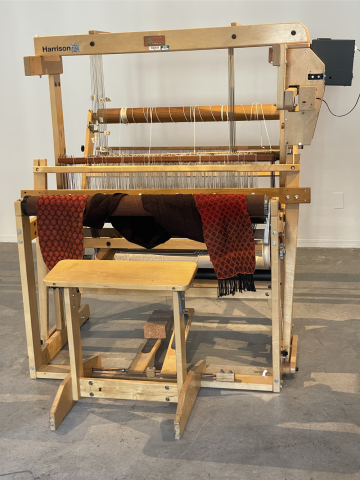
YAGER: The other thing that it meant is having university-scale access to studios. To have my own wood shop and metal shop and glass studio and fibre studio has been such a gift. It gave me the chance to fall back in love with Fibre. As a result of being in the fibre studio and working with Mackenzie Kelly-Frère and Jolie Bird, I discovered a kind of loom that allows me to weave with only one foot, which I am now able to bring into my practice at home. This love in turn impacted my glass work as I have developed a method for creating woven glass. I can't wait to get the loom set up at home after I finish.
AUARTS: Oh, cool.
YAGER: And so, my partner and I got engaged in October. I'm going to weave the fabric for my wedding dress.
AUARTS: Amazing.
YAGER: My sort of recuperation project. So I’m still making. Something very personal to me. Especially after finishing all of this.
AUARTS: Twenty months, right? How does AUArts compare to other schools?
YAGER: I am not overly familiar with other programs. I think the last time I had really looked around was probably 10-15 years ago, and I wasn't at a point where I felt entirely ready for an MFA. When I looked back then, I found that programs in the States would have been financially crippling for me.
So, to have a program that felt accessible and affordable, I could manage all those aspects of it. And it was multidisciplinary. I don't think there's a lot of MFA programs for Glass.
An interdisciplinary approach
AUARTS: I want to talk about how you're using video, animation, glass and ceramics in your piece. What made you want to combine those, and how does it help you express what you're trying to do?
YAGER: I've never had a background in filmmaking before.
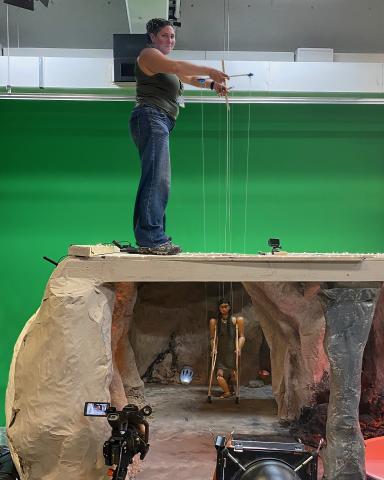
Prior to my amputation I was in so much pain that all my daydreams were about movement. And a blown glass object is not moving. But by making a film with a glass marionette, I can put the glass in motion.
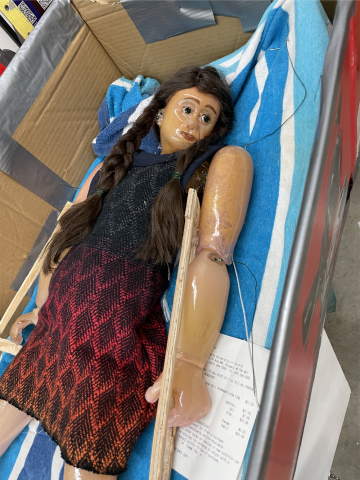
Creating the film was a way to incorporate movement and storytelling into my work. Because I made the marionettes in glass, and then made every element of the set, the process of making the film felt like a natural extension of my physical craft. The film draws on references from Plato's Allegory of the Cave, using shadows to lead the marionette out of the darkness of her cave of pain and loneliness. At the end of the film the glass marionette jumps into a pool of lava — a material that is very similar to molten glass and her literal beginning — and she rises transformed into the phoenix.
Bringing the phoenix to life
YAGER: She [the glass puppet] starts as this colourless marionette, out of glass, frosted, ghost-like, barely alive. And sees these shadows of what the future could look like. And it's enough to give her hope to move and to get up and to go towards the future. So, she stands up and uses her crutches to walk through the cave, led by these visions of what her life could be with an amputation that would free her from her pain.
And it ends with the puppet sort of jumping into this pool of lava. And that's got multiple layers to it. Lava and molten glass are very similar, so when she jumps into the pool of lava, it is a return to her literal beginning and a chance for rebirth as something new. In the hot shop, I use a blowpipe to reach into the pool of molten glass, gather this glowing, moving substance, and then use my breath and my hands to create something new.
But also, the quality of the pain from CRPS felt like standing in a pool of lava, with that level of burning heat and the compressive weight of liquid stone. So having lava be the transformative element felt narratively significant to me. She takes a leap of faith and glass transforms her life as she rises as a glass phoenix.
AUARTS: That is the best. I can't wait to actually see it.
So, your work in the IKG exhibition is all about the puppet turning into the phoenix and then how does your Marion Nicoll exhibition, Adapt, complement that? Is it showing behind the scenes or is it more than that?
YAGER: The exhibition in Marion Nicoll is all the tools and methods that I used to create the thesis project installation. So, a year into the program, I had started having problems with my prosthetic, I couldn’t wear it. And I was like, I don't have time to not make my phoenix.
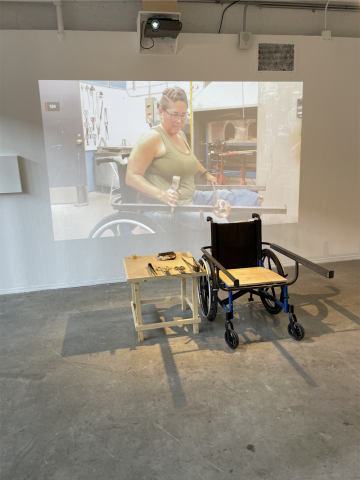
I've got to do this. So, how can I carry glass and a blowpipe if I’m on crutches? I can't carry that if I'm using my hands.
I have a wheelchair. Can we make the wheelchair part of glassmaking?
When the switch happened, it happened very quickly. I went from walking seven thousand steps a day to “I can't wear my prosthetic” in two days. We didn't know what to do. But my leg started to look like it did before the amputation.
And it was really scary. And I was in this limbo of not really knowing anything that was going to happen for about six weeks. Three days into that, I said, “Alright, it's time to make a glassblowing wheelchair.”
Because I gotta keep working, and working will keep me grounded. If I stop working. I'm just gonna spin out mentally and feel like I'm losing time again.
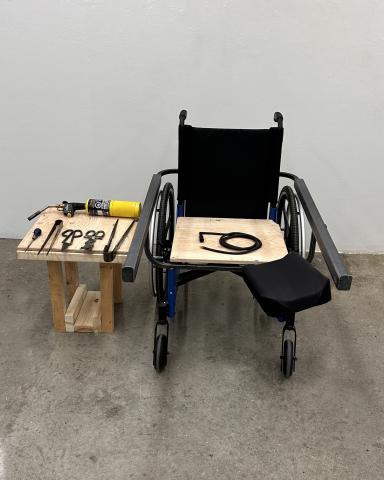
I'm not going to do that. I made sure to give myself access to all of these tools.
For the opening of the show I made a dress of fabric that I wove that has the same feathers as the woven glass of the phoenix.
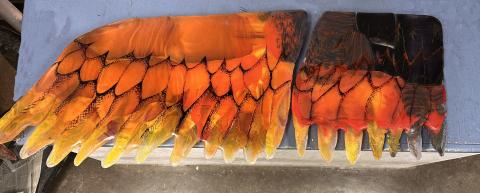
AUARTS: That's amazing. Has building those tools changed the way you thought about approaching things going forward?
YAGER: Yes and no.
As a person in a non-normative body, I have to make adaptations all the time. Making these adaptations in the day-to-day expands what I am willing and able to think of in the creative context because I'm used to looking outside the norm and coming up with new ways to do things.
It's habitual. And so, it's easier than having to start from “This is how it's done.”
I can't do the “This is how it's done, most of the time.”
I grew up in a family of engineers and folks that are problem solvers. I have six genius brothers.
AUARTS: Six brothers.
YAGER: And we were all really close and we were always playing outside and building things and making mechanisms to experiment on. We sort of had the tools and things to make it possible. And I feel like that's the origin of my approach to designing tools. It's something I have always done and that started as play, which I think is important.
Community at AUArts
AUARTS: Coming into Calgary, I'm assuming you not really knowing anyone besides your partner. How did you find the community at AUArts?
YAGER: It’s been amazing. We [our cohort] really bonded.
And we really appreciate each other's work. And there's another amputee in the cohort, and there’s only eight of us. How are there two amputees?!
There was a lot of synergy and good, sort of bonding there. The faculty are amazing. Being around the undergrads helped me as well. It's definitely made me stay young.
What comes next
The last question is about the MFA program. Now that you're at the end of it, what have you taken from it? Where do you want to go next? What would you recommend for other students that are thinking about taking it?
YAGER: I think the biggest thing that I have learned is trust the process.
For me, everything is grounded in research creation. So, it's an understanding that every act of making is making new knowledge. And going from the first iteration to tenth, you can be trying to make the same thing, but as your body takes on the knowledge of how to make the thing, each time it becomes a little bit more effective. That path will be a little bit easier to traverse. And you can build on it.
For me, the how is the why.
Make use of the facilities of other faculty and the techs. The techs have been amazing.
Use the breadth of studios and supports that are available. It will change you.
I've always loved school. So, the idea of going back to school is something that I've always dreamed of. And it all just came together.
There are so many things that I did for the first time in this project that I had one shot to get it right. And some of that is a testament to the ability to pivot and the ability to adapt to new things. And stick with it.
Because my ideas are really big. My work is really big. This phoenix is going to be two hundred pounds...
AUARTS: I can't wait to see how they hoist it up. When is the exhibition until?
YAGER: It opens on April 9, and it runs through the 18th.
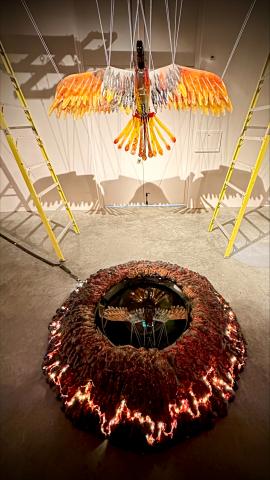
At the centre of Yager’s practice is a simple but hard-earned understanding: making is not a fixed process, but a living one. It shifts, adapts and evolves — just as the body does.
Her time at AUArts has been a space to test limits, rebuild methods and reimagine what a sustainable, self-defined practice can look like. Whether through glass, film or the tools she engineers herself, Yager’s work insists on possibility — on finding new ways forward when old ones no longer fit.
As she completes her MFA, that mindset carries forward. Not as an end point, but as an ongoing process of becoming — one shaped by curiosity, resilience and the courage to remake the world around her, on her own terms.
Follow Yager's work at @jessicayagerstudio on Instagram or visit www.jesiyager.com