Exhibition
11 Oct 1990 - 10 Nov 1990
Illingworth Kerr GalleryThe Power Chord Cycle
Christian Eckart
Christian Eckart’s the Power Cord Suite strikes and holds its deep, sonorous notes the moment you cross its threshold.
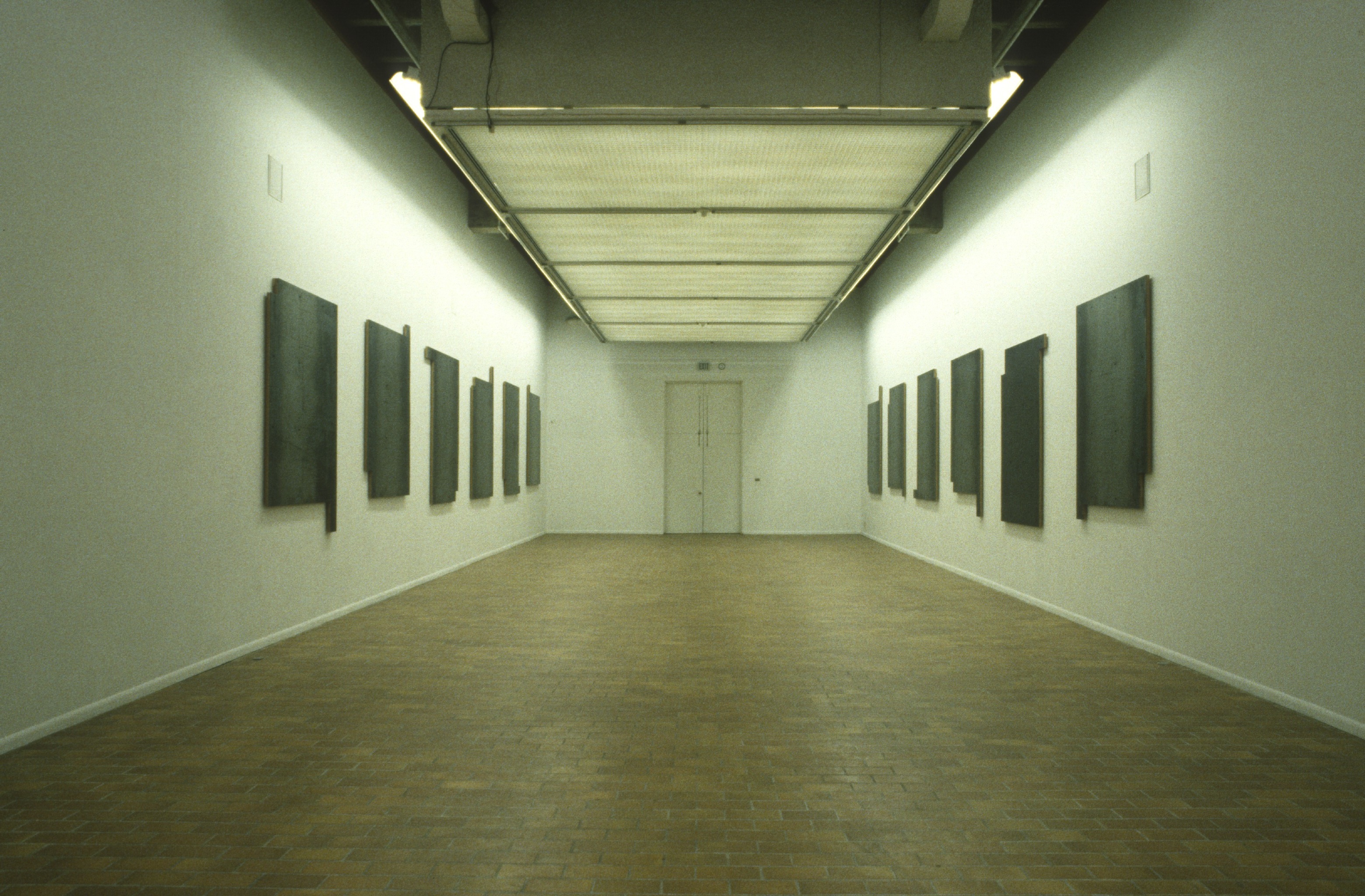
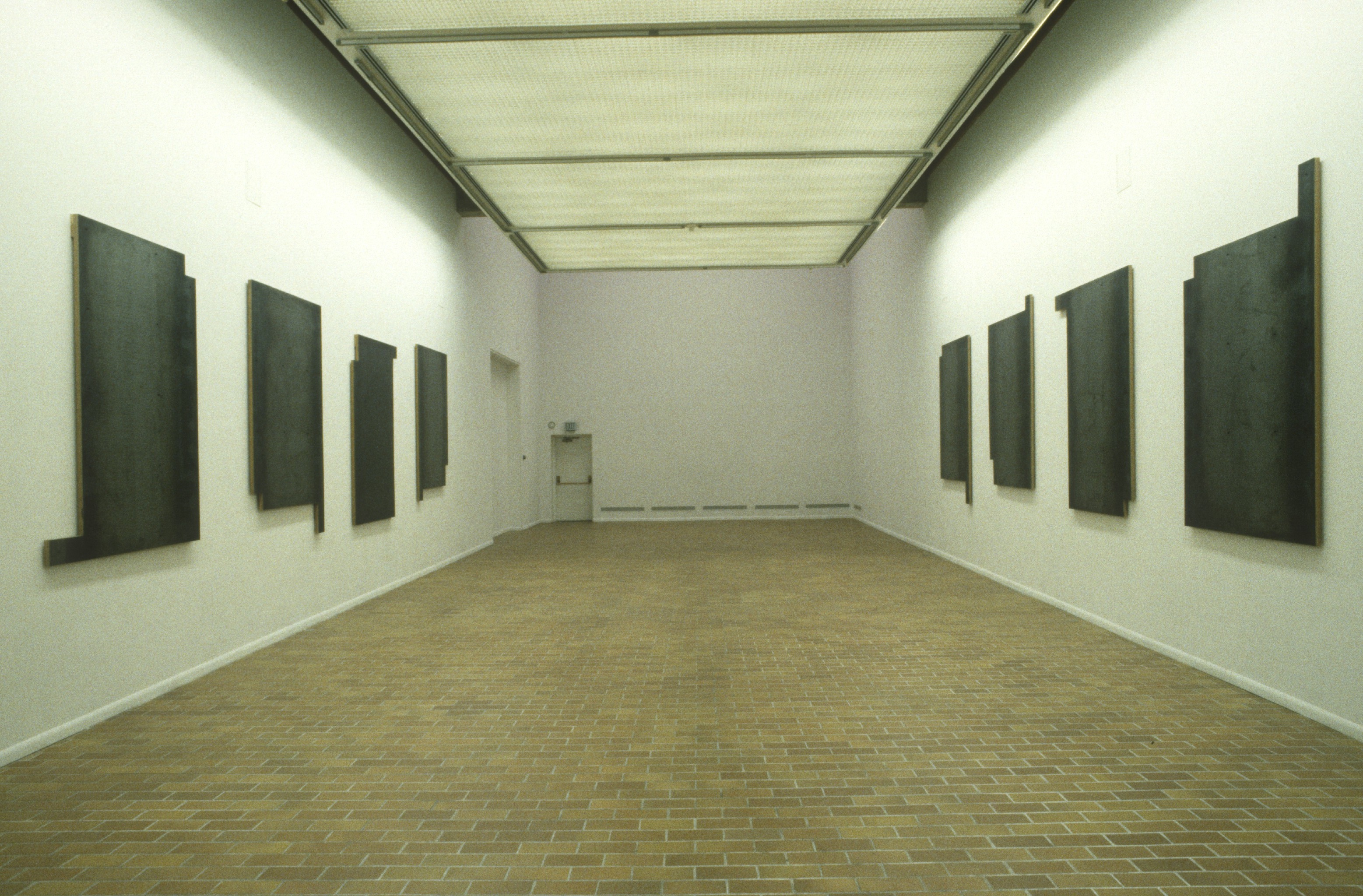
The vision is chilling, weighted like a full sound with a cold, rich organ tone and skirting high notes at the top. Embodied by 12 large, notched steel "paintings" that march in sixes down two sides of the gallery towards a purplish light, falling from the higher ceiling at the far end, this is a powerful, contemporary evocation of the sublime.
It's also a preview of the newest work by a brilliant 31-year-old artist, who was graduated from the Alberta College of Art in 1984 and, in six years, has become one of the most interesting young painters in New York and in Europe. But Eckart, not content to show up at his alma mater with an exhibition of older works, decided to test a new, tougher direction here, with his first installation designed to use architecture as it exists.
Landscape painters of the 19th century evoked the simultaneous experience of terror, beauty and awe that characterizes the sublime by confronting man, small and frail in his humanity, with the majestic and uncaring spectacle of nature. Ekart’s synthesis of terror, beauty and awe rises up out of allusions to the mass ecstasy induced by heavy-metal rock music, the spiritual focus of abstract painting, and the industrial progress that inhabits architecture. They aren’t parallels, he says, but they speak to the human need for transcendence and the spectacles that people consume to seek it in the secular world.
In the Power Cord Suite, transcendence is invoked by the symbolic radiant light high up in the gallery. It’s heaven, a godhead of fluorescent tubes surrounding a large, two-panel grill concealing unused ceiling lamps. Built into the architecture, it’s clearly a utilitarian structure. But you are drawn to it, down to the processional of untreated steel paintings (which evoke a certain kind of abstract painting quite well), by the attraction of colored light. And the processional thrills even as you realize how it plays upon your desire for faith.
“This is a more critical piece than normal for me,” Eckart says. “My idea was to make a church like architectural installation that creates a nexus between three versions of the sublime—heavy meatal music abstract painting and industrialism. You make the space disclose its own imperatives as a church, as a mausoleum, as an art gallery.
“That's not to critique the gallery. It’s to discuss how we manufacture ourselves.”
The history of architecture and the history of painting, from the religious art of the Middle Ages to the secular spiritualism of 20th century abstraction, fuel each of the 13 series of works Eckart has been making concurrently for the past six years. As a student he was seduced and fascinated by abstract painting, he says. Now his paintings are about painting, power, seduction, and how works of art are utilized by societies as artifacts of belief. To differentiate himself from the artistic ideologies he admires and, at the same time, deconstructs, his paintings are actual constructed objects, as physical, material, and non-illusionistic as he can make them. They are emblems, artifacts in the world.
Disclosing and questioning the purpose of art is Ekart’s constant theme, especially as it’s used by men to externalize their sense of purpose in relation to the void. This new work raises new questions, pointing to the power of control through spectacle and engrained social beliefs.
- Nancy Tousley, Calgary Herald, 1990
Christian Eckart, a 31-year-old artist from western Canada, has lived and worked in Brooklyn since 1984, the year he graduated in sculpture from the AUArts in Calgary and Moved to New York to study at Munter College, where he completed his MFA degree in painting in 1986.